MUSC’s $1.1 Billion Cancer Hospital Heads to Charleston Design Review
The proposed 14-story hospital would bring inpatient and outpatient cancer care under one roof, add South Carolina’s only proton therapy center and reshape a major section of MUSC’s downtown Charleston campus.
One of the largest health care projects currently planned in South Carolina is taking another step forward in downtown Charleston.
The Medical University of South Carolina’s proposed Comprehensive Cancer Hospital is scheduled to go before Charleston’s Board of Architectural Review-Large on Wednesday, Sept. 9, as MUSC seeks conceptual approval for the new facility at 16 Sabin Street. The city’s official agenda lists the cancer hospital as the third application to be considered at the meeting.
The project carries a current estimated price tag of $1.115 billion, including approximately $885 million in construction costs and $230 million for equipment and furnishings, according to MUSC. The estimate is based on the project scope as of Jan. 26, 2026 and remains subject to formal budget approval by MUSC’s Board of Trustees.
If completed as planned, the hospital would become a major new landmark on Charleston’s medical district skyline — and a centerpiece of MUSC’s effort to transform cancer treatment throughout South Carolina.
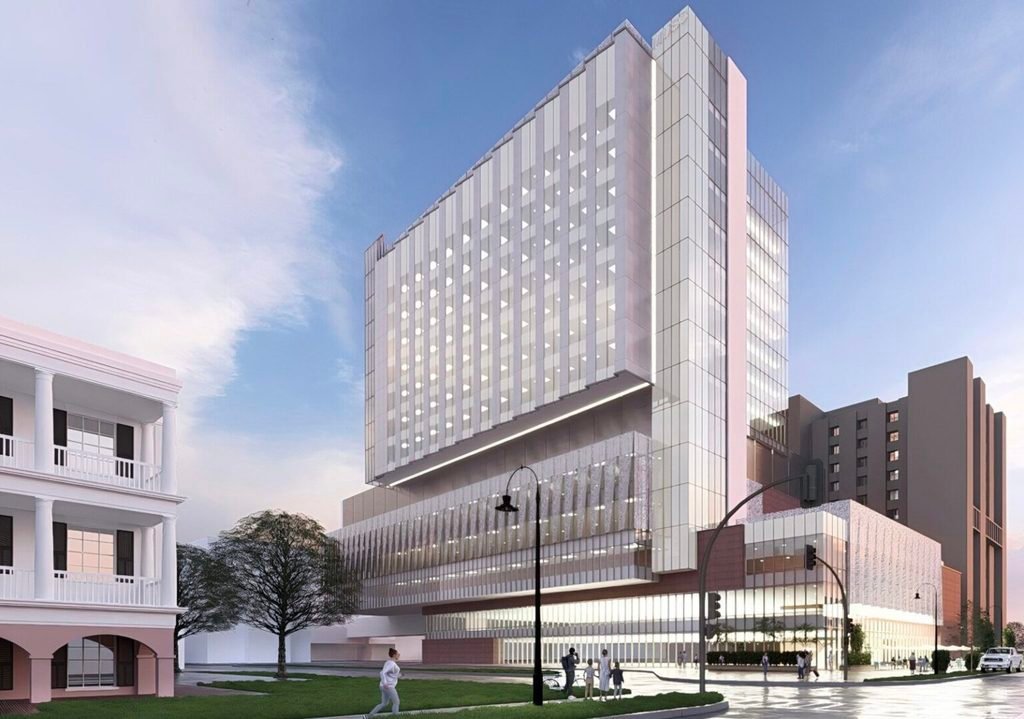
A 14-story cancer hospital in downtown Charleston
Current plans call for a roughly 600,000-square-foot, 14-story facility near Ashley Avenue, Calhoun Street and Rutledge Tower.
The building would become the tallest structure on MUSC’s downtown campus while remaining below Charleston’s 250-foot downtown height limit.
MUSC initially approved planning and construction of the hospital in April 2025, identifying an area along Ashley Avenue and Sabin Street that includes the footprint of the existing Rutledge Tower annex, energy plant and surface parking.
Wednesday’s BAR appearance does not represent final approval or the beginning of construction. MUSC is seeking conceptual approval, meaning Charleston’s architectural board will review the project’s overall design and how a building of this scale fits within the city’s historic and medical districts.
What is planned inside?
Unlike MUSC’s existing cancer services, which are currently spread among multiple buildings, the new hospital is designed to place much of the patient experience in a single location.
Plans currently include:
- 100 inpatient rooms
- 124 examination rooms
- 14 operating rooms
- 94 chemotherapy and immunotherapy infusion chairs
- A 24/7 urgent care unit specifically for cancer patients
- Radiation oncology
- Stem cell transplantation
- Cellular therapies, including CAR T-cell treatment
- Gamma Knife radiosurgery
- Intraoperative MRI
- Phase I clinical trials
- Precision medicine programs
- Dedicated imaging, pathology, laboratory and pharmacy services
MUSC says research and education are also being incorporated directly into the building, creating space for scientists, physicians and clinical-trial teams to work alongside one another.
South Carolina’s only proton therapy center is planned
One of the project’s biggest additions would be proton therapy.
MUSC says the proposed hospital would contain the only proton therapy center in South Carolina. Proton therapy is an advanced form of radiation treatment that can deliver radiation more precisely to certain tumors while limiting exposure to surrounding tissue.
The hospital itself would also become South Carolina’s first hospital dedicated exclusively to cancer care, according to current project reporting.
For some patients, that could mean receiving highly specialized treatment in-state rather than traveling elsewhere in the Southeast.
Why MUSC says South Carolina needs it
MUSC is positioning the Charleston hospital as the hub of a much broader statewide cancer-care ecosystem.
Hollings Cancer Center is currently South Carolina’s only National Cancer Institute-designated cancer center. MUSC wants the new hospital to anchor a network of cancer services and clinical trials reaching patients around the state.
MUSC says South Carolina currently sees approximately 35,000 new cancer cases and 11,000 cancer-related deaths each year, with new cases projected to increase significantly over the coming decade.
In April, MUSC launched a $250 million capital campaign to help support development of the new hospital. The organization says government funding, institutional resources and private philanthropy are expected to contribute to the overall project.
It’s part of a much larger MUSC transformation
The new cancer hospital is not happening in isolation.
MUSC is simultaneously reorganizing and expanding facilities throughout the Charleston region.
A new outpatient medical building at 334 Calhoun Street is expected to open in December 2028. Services currently housed in Rutledge Tower are being moved into that facility and other MUSC locations in West Ashley, North Charleston and the Summerville/Nexton area.
Cancer services currently housed within the existing Hollings Cancer Center would eventually move into the new hospital, allowing more of the existing building to be converted for cancer research.
Rutledge Tower itself is ultimately expected to be redeveloped for mixed use.
The broader downtown master plan also addresses parking, infrastructure, stormwater management, green space, energy needs and resiliency as MUSC prepares its campus for decades of additional growth.
When could the new hospital open?
MUSC’s current timeline calls for the Comprehensive Cancer Hospital to open in April 2030.
There are still multiple design, approval and construction milestones between now and then.
For today, the next step is Charleston’s architectural review.
The Board of Architectural Review-Large meets at 4:30 p.m. Wednesday, Sept. 9 in the Public Meeting Room at 2 George Street. The meeting will also be livestreamed and recorded through the City of Charleston’s public meetings channel.
Whatever the board ultimately decides about the current design, the scale is already clear: MUSC is planning a more than billion-dollar investment that could significantly change both Charleston’s medical district and how cancer care is delivered across South Carolina.