Charleston Plans Faster Pothole Repairs — And Every Traffic Signal in West Ashley Is Set for Retiming
A planned agreement with SCDOT would let Charleston crews repair more state-owned roads, while regional transportation funding will be used to retime traffic signals throughout West Ashley.
Charleston is preparing to take a more direct role in two frustrations West Ashley drivers know well: potholes and traffic signals.
During the city’s Sept. 15 State of Our City event for West Ashley, Mayor William Cogswell announced that Charleston intends to enter into an intergovernmental agreement with the South Carolina Department of Transportation that would give city crews expanded authority to repair state-owned roads inside Charleston. The city also says it has secured Charleston Area Transportation Study funding to retime every traffic signal in West Ashley.
Why Charleston couldn’t simply fix many potholes before
One of the more important details behind the announcement is road ownership.
According to the city, roughly half of the roads inside Charleston are not city-owned, including heavily traveled corridors controlled by the state. Historically, that has limited where Charleston’s own maintenance crews could perform repairs, even when the problem was inside city limits.
Under the planned SCDOT agreement, Charleston says it would be able to perform more repairs on those state roads rather than waiting exclusively on the state.
The city says the expanded program could allow crews to repair approximately 20 to 30 potholes per day. Charleston is also adding a second repair crew and truck, funded with excess revenue generated by increased hotel and business-license fees.
A dedicated pothole hotline is also planned for early 2027, giving residents another direct way to report problem areas.
West Ashley’s traffic lights are getting a broader reset
The other half of the announcement could affect far more drivers day to day.
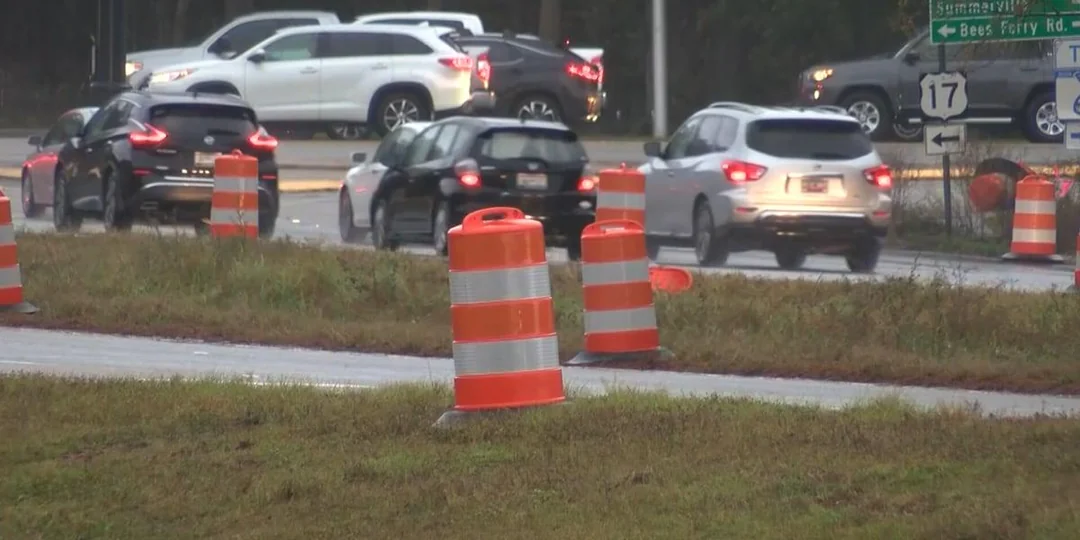
Charleston says it has secured regional CHATS funding to retime every traffic signal in West Ashley in an effort to improve traffic flow.
Signal retiming does not necessarily mean adding new roads or lanes. Instead, engineers adjust when lights change and how intersections coordinate with one another so traffic can move more efficiently through a corridor.
Charleston already operates and maintains more than 200 signalized intersections citywide, including many signals that are actually owned by SCDOT.
The city pointed to its work on the Calhoun Street corridor as evidence that signal changes can produce measurable improvements, saying traffic flow there improved by roughly 25%. Charleston’s Calhoun project uses adaptive technology and camera-based detection to adjust timing according to real-time traffic, pedestrian and bicycle conditions.
That 25% figure should not be read as a guarantee that West Ashley will see the same improvement. The corridors, traffic patterns and technology involved can differ. But it explains why signal timing has become part of Charleston’s broader strategy for addressing congestion without waiting for major road-widening projects.
This fits into a much larger West Ashley transportation push
The signal work is not happening in isolation.
West Ashley already has multiple transportation projects moving through planning or construction, including intersection upgrades along Savannah Highway designed to improve vehicle movement while adding safer pedestrian and bicycle crossings. Those projects include proposed turn-lane changes at Wappoo Road and improvements around Dupont Road and Stinson Drive.
Long-range West Ashley planning documents have also called for improved and more responsive signal timing for years, including adaptive controls along major corridors.
The latest announcement brings two comparatively immediate strategies into that larger picture: giving local crews more ability to address road damage and attempting to squeeze more efficiency out of the signal network already in place.
What West Ashley drivers should watch next
There are still important details to come.
The city has announced its intention to enter the SCDOT agreement, but WGOIC has not found confirmation that the agreement has been finalized yet. A precise timetable for completing the West Ashley signal-retiming program also was not included in the city’s announcement.
What is confirmed is that Charleston says funding for the signal work has been secured, a second pothole crew is being added, and a public pothole-reporting hotline is planned for early 2027.
For a part of Charleston where transportation and growth remain persistent concerns, those details will be worth following as the projects move from announcement to implementation.
WGOIC will continue tracking the West Ashley transportation projects as timelines and additional details become available.